
The Final Negotiations in Oujda Between the Riffians, France, and Spain in 1926
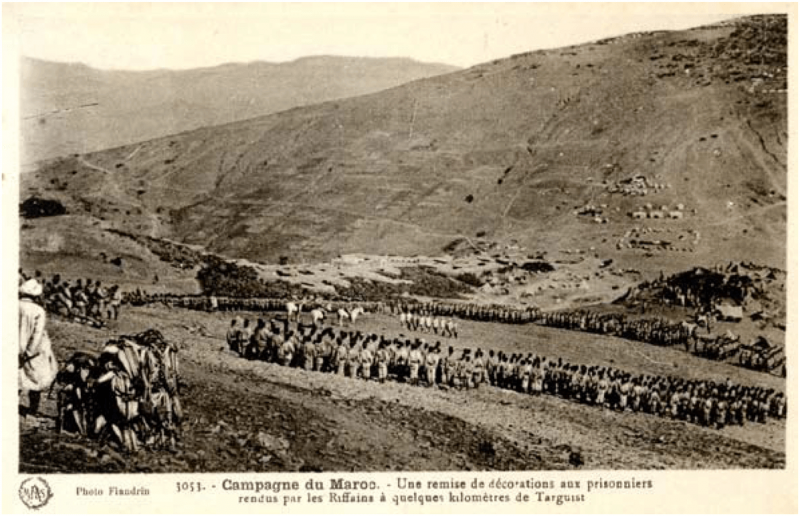
On May 7, 1926, the peace negotiations between the Riffian government and the French and Spanish colonial powers came to an end. These negotiations had started on April 17, 1926, and took place in the city of Oujda. The Riffian government was represented by the following negotiators: Mohamed Azarkan, Minister of Foreign Affairs and head of the Riffian delegation; Haddou Ben Hammou Lakhal, responsible for General Affairs, diplomacy, and communication with France; and Mohamed mmis n Rḥadj Cheddi, the second highest official in the Ministry of Foreign Affairs after Azarkan and a close adviser to the president of the Rif Republic, Mohamed Abdelkrim Khattabi.
The goal of the negotiations was to bring an end to the war in the Rif. The talks took place after the Riffians had made their cause known internationally and after several peoples around the world had expressed solidarity with the Riffian people.
Because of this growing support, Spain sought help from France. The two imperial powers then agreed to negotiate with the Riffians, whom they had previously underestimated and refused to recognize. They also hoped that the negotiations would distract their own populations, many of whom were against continuing the war against the Riffians.
Among the main demands presented to the Riffians were:
· the exile of the president of the Rif Republic, Mohamed Abdelkrim Khattabi;
· placing the Rif under the authority of the Sultan of Fez;
· the complete disarmament of the Riffians.
France and Spain also proposed a form of self-government for the Rif under the sovereignty of the Sultan of Fez, who had signed the protectorate treaty with France. However, the Riffians considered these proposals unacceptable. They wanted only the recognition of Riffian independence, the goal for which they had always fought.
The Riffian delegation rejected these conditions. Each side remained firm in its position, and no agreement was reached during the negotiations in Oujda. The Riffians became even more convinced that they could rely only on themselves.
France, together with the Sultan of Fez, had already gathered a large military force in the south of the Rif. Spain also had a strong army in the Riffian territories it occupied and launched attacks on the Rif from there. The capital of the Rif Republic, Ajdir, had already fallen into enemy hands in 1925 after the landing in the Bay of Al Hoceima.
This landing was a military amphibious operation that took place on September 8, 1925, in the Bay of Al Hoceima. It was carried out by the Spanish army and navy, with support from French naval and air forces. The operation marked an important turning point in the Rif War and is considered one of the first modern amphibious operations in which tanks and air support were used together. It is also seen as a precursor to later Allied amphibious landings during the Second World War, such as the Normandy landings.
Foreign mercenaries also took part in the war in the Rif, including American pilots and German and Portuguese mercenary soldiers.
This marked the beginning of the downfall of the young Riffian state. According to many observers, the negotiations in Oujda in 1926 were only a performance meant to justify the colonization of the Rif in a seemingly legitimate way. Similar examples would later appear in the Madrid Agreement of April 7, 1956, between the Spanish dictator Franco and Sultan Mohammed V, as well as during the Aix-les-Bains Conference of August 22, 1955, between ‘Moroccan’ representatives and France.