
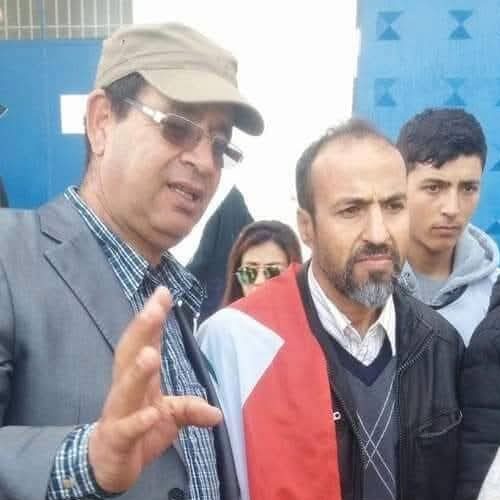
The struggle of the Riffian activist Mohamed Jelloul
Many social movements emerged in the Rif over time, such as those of February 20 in 2011 and 2012 and the so-called Rif Hirak in 2016 and 2017. Masses of people took to the streets to demand their fundamental rights.
These social movements knew many human rights activists and a number of them have become known to the general public through the (social) media, but some have not. During the Riffian People’s Movement ‘Hirak Rif’, among others, Nasser Zefzafi, Nabil Ahamjik, Salah Lakhcham, Abdel Ali Hoed, Silya Ziani and Abdelhak El Fahsi attracted attention.
One activist who did not immediately attract the attention of the media during the protests that sparked after the murder of Mohsin Fikri in 2016 is Mohamed Jelloul.
This special Riffjn activist is distinguished from others by the calm and slow tone in which he speaks and because he is often accompanied by his family during the demonstrations. During the manifestations, for example, he can often be seen with his mother, his wife and his children. This may be called special within the demonstrations of the Riffian People’s Movement.
Who is actually Mohamed Jelloul?
Mohamed Jelloul was born in 1971 in Tifarouine in Ayt Bouayach, within the Al Hoceima region in the Rif. He grew up in a family of five children, three boys and two girls, of which he is the second oldest. Like many Riffians, his father had moved to France for work. When Jelloul was six years old, his father brought the family to France. After 6 years of estrangement and hard work, the father decided to return to the Rif because he had an idea to build a future in his own country.
Mohamed Jelloul completed primary education in the Iboulay school in Ayt Bouayach and completed the university education in Oujda. He did teacher training, and, after obtaining his diploma, he started working as a primary education teacher in several Riffian villages.
From an early age, Mohamed Jelloul was interested in the issue of human rights in the Rif. He became active in the movement at the Uqba Ibnu Nafi secondary school in Ayt Bouayach. With his friends from this movement he demonstrated in 1987 against the oppression and injustice in the Rif. That year, Jelloul was arrested for the first time by Moroccan political police. During these demonstrations, two students died as a result of the actions of the ‘security forces’: 22-year-old Farid Akrouh and 16-year-old Said Bouddeft.
Even after completing his education and while working as a teacher, Mohamed Jelloul continued to campaign for human rights and to show solidarity with the marginalized groups in the Rif, such as the unemployed academics, fishermen, farmers, etc.
He was active in various associations and trade unions. But the general public was not yet aware of this activist.
During the February 20th Movement in 2011, his role as an activist stands out and he becomes known and popular with the general public in the Rif. However, this notoriety is not without consequences in the Rif. On March 12, 2012, Mohamed Jelloul is arrested by the Moroccan political police. He was kidnapped while working at a school in Ayt Hdifa and forced to leave everything behind: his job, his family and children, who had to miss their father from an early age, his youngest son was 10 years old.

Jelloul was married to Souad Ambarek in 1996. The family had three children: Houda in 1997, Ayoub in 1999 and Kamal in 2002. Souad had known her husband well before she married him and knew that he was an activist and therefore at risk of persecution and kidnapping by the Moroccan regime.
This does not alter the fact that difficult times began for Souad and her family after the arrest. But with the support and love of her family and because she kept her feet on the ground, the family managed to survive.
There followed a political trial of Mohamed Jelloul, which had nothing to do with law and justice. It was the regime’s revenge on a well-known Riffian activist and also a warning to his fellow activists. This process is part of a long tradition of oppression and repression, a policy pursued by the Moroccan regime in the Rif since the transfer of power from Spain in 1956.
Mohamed Jelloul was released on April 11, 2017. On the day of his release, he was welcomed at Tifelt prison by fellow activists, family and friends. On the way home he was greeted with much love in the places he visited. In his hometown of Ayt Bouayach he was treated by Riffian activists as a hero and received many visitors on the occasion of his release.
On his release, he took no rest and immediately took part in the Riffian protests that broke out after the murder of Mohsin Friki in 2016. He spoke during several demonstrations and attended with his mother, wife and children.
Six weeks after his release, on 26 May 2017, he was kidnapped again by the Moroccan political police. While eating in a cafeteria belonging to his in-laws, he was kidnapped by a group of strange people, who claimed to be from the police. Jelloul’s family was surprised that no warrant for his arrest had been issued. This arrest was the start of a large wave of arrests among the activists in the Rif. His kidnapping, like the kidnappings that followed, was accompanied by a lot of violence, aggression and serious insult towards Jelloul’s family and relatives. The Moroccan political police behaved worse than a criminal gang! They arrested Jelloul without showing a warrant and treated the family with disrespect. After this kidnapping, the family was left in the dark about Jelloul’s whereabouts for three days.
On June 19, 2017, his minor daughter Houda, along with four other minor girlfriends, was arrested by the police during a sit in for the release of the Riffian detainees in Al Hoceima. They were released after they, with the exception of Jelloul’s daughter, signed a statement not to demonstrate anymore.
Mohamed Jelloul, along with other kidnapped activists from the Riffian people’s movement, was taken with a great display of force by an army helicopter from Al Hoceima to Casablanca, which is more than 600 km from his hometown.
Then a long show process began in Casablanca. Jelloul was charged with “undermining internal state security”, “incitement against territorial unity”, “insulting” officials and institutions and organizing unauthorized protest. Jelloul was sentenced to 10 years in prison, on appeal that took place in 2019 this sentence was upheld.
Amnesty International wrote in a statement regarding the arrests and convictions of the Riffian activists:
[After their arrest, none of the convicts had immediate access to their lawyers. They were transferred more than 600 km away to Casablanca for questioning, making it difficult for their lawyers to prepare a proper defense and to visit their families. Several reported signing “confessions” obtained in custody by torture or under threat of torture.
In July 2017, the Justice Minister announced an investigation into at least 66 cases of suspected police torture or other ill-treatment of demonstrators in custody. Judges have also so far failed to exclude statements that may have been obtained under torture as incriminating evidence against the defendants in their trials, in violation of Morocco’s international obligations against torture and due process.]
By: Media Committee of The National Assembly of Rif, N.A.R.
Oslo, 19/12/2021
Sources:
– Interview of the media committee N.A. R. with d Mrs. Souad Ambarek in December 2021
Release daughter of Jelloul:
-Rue20
-Hespres
Amnesty International Statements on Convicted Rif Activists
– Amnesty 1
– Amnesty 2
1
